

 Search
 enquiry@vinsys.com
 +91 9579124337
 18752 participants
 Looking for Corporate Training
5-day instructor-led live training, delivered online or as customized corporate training
What is the AI Agents for Technical Enablement & Digital Transformation training? It's a 5-day instructor-led course in India for technical professionals — developers, architects, and IT teams — covering AI Agent architecture, prompt engineering, Retrieval-Augmented Generation (R...
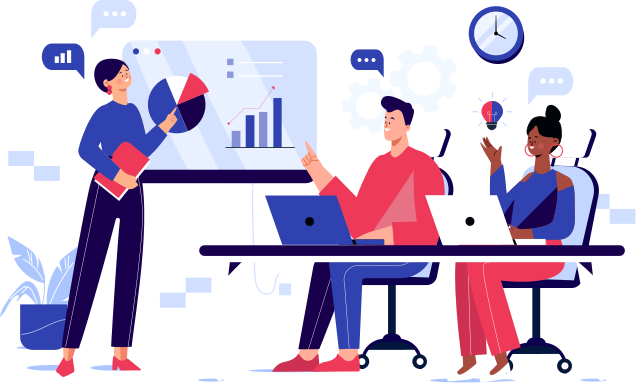

The learning journey starts with AI Agent architecture, reasoning models, orchestration, and how AI Agents differ from chatbots, traditional automation, and standalone LLMs. From there, the program moves into advanced prompt engineering, enterprise knowledge integration, and Retrieval-Augmented Generation (RAG) — the techniques that let AI Agents retrieve and act on real organizational data rather than generic responses.
Enterprise connectivity is a core focus: participants work hands-on with integrations into Microsoft 365, SharePoint, ERP applications, CRM platforms, APIs, and workflow automation tools. The program closes with governance, security architecture, evaluation, deployment planning, and operational monitoring — the practices enterprises need before any AI Agent goes into production.
Loading...

Why Choose Vinsys for AI Agents Training in India?
Vinsys is recognized as one of India's leading corporate training providers and a leading B2B training company, with particular strength in technical IT courses, professional certifications, and consulting-led digital transformation programs. Vinsys was named a Best Corporate Training Company in India and a Top Corporate Training Company 2025 by TechBehemoths and SuperbCompanies — two well-known global B2B review platforms.
How is an AI Agent different from a chatbot?
A chatbot follows scripted or reactive conversation flows. An AI Agent reasons over multi-step tasks, retrieves enterprise knowledge, makes autonomous decisions within defined boundaries, and can take actions across connected systems — not just respond in a conversation.
What skills do I need before taking an AI Agents course?
No advanced programming background is required. A working familiarity with enterprise software, cloud platforms, or automation concepts is enough to follow the technical labs, though developers and architects will get the most from the hands-on integration modules.
Can AI Agents integrate with SAP or Salesforce?
Yes. AI Agents can be connected to enterprise platforms like SAP, Salesforce, and other ERP/CRM systems via APIs and workflow automation layers, allowing them to retrieve records, trigger processes, and support business operations directly inside those systems.
Is this course suitable for non-developers?
Yes, with the caveat that it's built for technical roles broadly — architects, analysts, PMOs, and automation specialists — rather than purely non-technical business users. Deep coding experience isn't required, but comfort with enterprise IT concepts is expected.
What is agent orchestration in enterprise AI?
Orchestration is how multiple AI Agents (or an agent and its sub-tasks) are coordinated to complete a larger workflow — deciding sequencing, handoffs, and escalation so a complex business process is handled reliably rather than as one unmanaged task.
How do enterprises govern and secure AI Agent deployments?
Through access controls, audit logging, human-review checkpoints for high-risk actions, defined escalation paths, and ongoing performance/risk monitoring — all covered in Module 5 of this course.
What is the difference between AI Agents and Retrieval-Augmented Generation (RAG)?
RAG is a technique AI Agents use to retrieve and ground responses in enterprise knowledge. AI Agents are the broader system — they use RAG, along with reasoning and orchestration, to autonomously complete multi-step tasks.
Why choose Vinsys for AI Agents for Technical Enablement and Digital Transformation training in India?
Expert-led instruction, enterprise-focused technical labs, real-world implementation scenarios, hands-on workshops, and practical guidance to build, deploy, and scale enterprise AI Agent solutions with confidence — backed by Vinsys's recognition as a Best Corporate Training Company (TechBehemoths, SuperbCompanies, 2025).
How does this programme support enterprise digital transformation?
By equipping participants to implement intelligent automation, integrate AI across enterprise environments, improve operational efficiency, and support long-term AI-driven business transformation.
What outcomes can participants expect after completing the programme?
The ability to design enterprise AI Agent architectures, build functional prototypes, define integration strategies, establish governance frameworks, and prepare implementation roadmaps.
Does the course explain how AI Agents integrate with enterprise systems?
Yes — the programme demonstrates AI Agent connections to enterprise applications, business platforms, knowledge repositories, collaboration tools, APIs, and workflow automation solutions.
Which enterprise platforms and technologies are introduced during the programme?
Microsoft 365, SharePoint, ERP systems, CRM platforms, APIs, RAG, workflow automation tools, cloud-based AI services, and enterprise AI development environments.
Does the programme include practical labs and implementation exercises?
Yes — technical laboratories, guided workshops, architecture design activities, prototype development exercises, and enterprise case studies.
What practical skills will participants gain during the training?
Designing AI Agents, integrating enterprise knowledge sources, automating business workflows, connecting AI with enterprise platforms, implementing governance controls, and preparing AI solutions for production.
Is programming experience required before attending the course?
No. Familiarity with enterprise technologies is beneficial, and the programme accommodates varying technical backgrounds by covering both concepts and practical implementation.
Who is the ideal audience for this training programme?
Software developers, solution architects, IT professionals, system analysts, automation specialists, cybersecurity professionals, data and analytics teams, technical project managers, and digital transformation professionals.